What the Lining Knows: A Case for Judging Bags by the Parts We Never See

Photo by Photo by Ries Bosch on Unsplash on Unsplash
There is a peculiar theatre to buying a handbag in Britain. We queue politely outside flagship stores on Bond Street, we admire the window displays, we hold the bag up to the light and stroke the leather as though we know precisely what we are feeling. And then we buy it — often without once looking inside, turning it over, or examining the one component that will fail first: the strap stitching.
We would like to make an impolite suggestion. Ignore the logo. Look at the lining.
The Logo Tells You Who Made It. The Details Tell You How Long It Will Last.
A brand name is a promise of intent, not a guarantee of construction. Heritage houses with centuries of history produce bags with plastic linings and glued-in zips; newer labels with no pedigree whatsoever build bags with saddle-stitched handles and solid brass hardware. The inverse is equally true. The point is not that reputation means nothing — it is that reputation should be verified, not assumed.
The components nobody photographs are the ones doing the structural work. A bag spends its life being stuffed, dropped on rush-hour trains, dragged across the seats of Northern line carriages and left leaning against pub radiators. It fails from the inside out: the zip tape frays, the lining splits along a seam, the edge paint flakes away from raw canvas. No monogram canvas prevents any of this. Good construction does.
Four Things to Inspect Before You Hand Over Your Card
The zip. Turn to the inside and read the back of the zipper pull. If you see a maker's stamp — Riri, Lampo, YKK Excella — you are looking at hardware that can be repaired and replaced for decades. An unbranded zip is not necessarily fatal, but it is the single most common point of failure in a mid-priced bag, and once it goes, the bag is often written off.
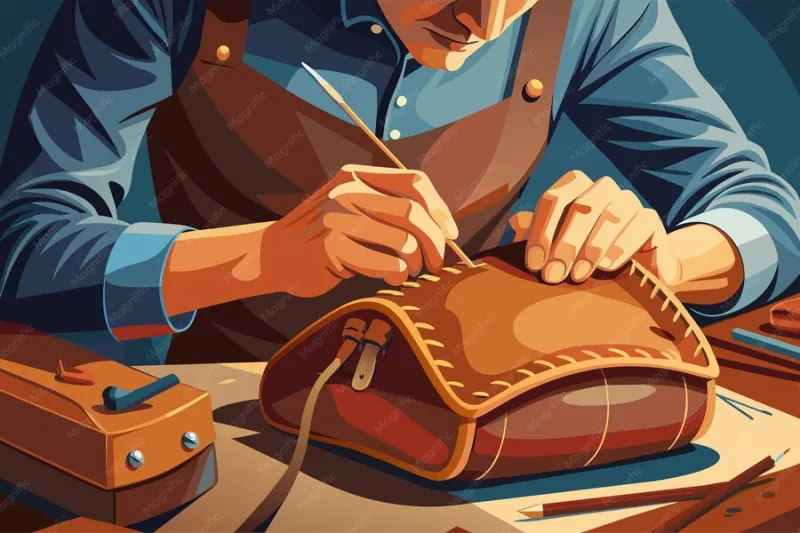
The stitching. Count the stitches per inch along a handle or strap — you can do this discreetly, we promise. Eight to twelve stitches per inch suggests machine work done properly; hand saddle-stitching will show fewer, slightly irregular stitches and is arguably superior still, because each stitch is an independent knot. What you are really checking for is straightness, even tension, and back-stitching at stress points. A handle attached with three stitches and a prayer will not survive a British winter of coat-and-scarf snagging.
The lining. Open the bag wide and look at how the lining meets the exterior. Is it sewn, or is it glued? Does it bunch loosely at the corners? A tightly sewn lining in cotton twill, suede or quality leather moves with the bag; a glued synthetic liner eventually detaches in sheets, and its removal is a costly repair.
The edge paint and hardware. Run a thumb along the painted edges of the leather. Quality edge paint is applied in thin, cured layers and feels smooth and slightly flexible. A thick, brittle coating will crack within a year, particularly on bags that live through our damp autumns. As for hardware: solid brass or palladium-plated fittings develop a patina; hollow, lightweight alloys simply corrode.
The High Street Is Not the Enemy
It is tempting to assume that only a four-figure bag passes these tests, but that is a convenient myth perpetuated by people who sell four-figure bags. Several accessible British and European labels — and a good number of independent makers selling through markets in London, Manchester and Edinburgh — produce bags with sewn linings, branded zips and properly finished edges at prices that would not raise an eyebrow at a till in John Lewis.
Equally, do not assume a famous monogram guarantees the reverse. Some of the most repair-resistant bags we have examined were decades-old pieces from unfashionable makers who simply built things properly. This is precisely why the UK's resale market has become so vigorous: informed buyers can now identify a well-made bag from any era, at any price point, and pay accordingly.
A Two-Minute Ritual
Next time you are in a shop, resist the urge to admire the bag from across the counter. Pick it up. Open it. Look inside. Turn it over. Read the zip. Run your thumb along an edge.
It is not especially elegant, and a patient sales assistant will not mind — indeed, the good ones respect it. Because the truth about a bag that lasts a lifetime is that its biography is written in the details nobody photographs. The lining knows. So, now, do you.